
GENERATIVE RESEARCH · SOLO PROJECT
BreatheSpace
A 28-person survey revealed an opportunity for flexible, low-friction mindfulness support.
Role
UX Researcher / Concept Designer
METHODS
Survey design, synthesis, opportunity framing, and concept direction
PARTICIPANTS
28 survey respondents
PROJECT STATUS
Research-informed concept direction
THE OPPORTUNITY
Mindfulness support has to fit real life.
People may value mindfulness while still struggling to find time, quiet, or an approachable way to practice. The opportunity was to understand what could make support feel easier to begin in small, everyday moments.
Research
Listen for the barriers behind good intentions.
A 28-person survey explored how people currently make space for mindfulness, where existing routines break down, and what kinds of support feel realistic when time, energy, or privacy are limited.
RESEARCH OUTCOME
Three principles to take into concept testing.
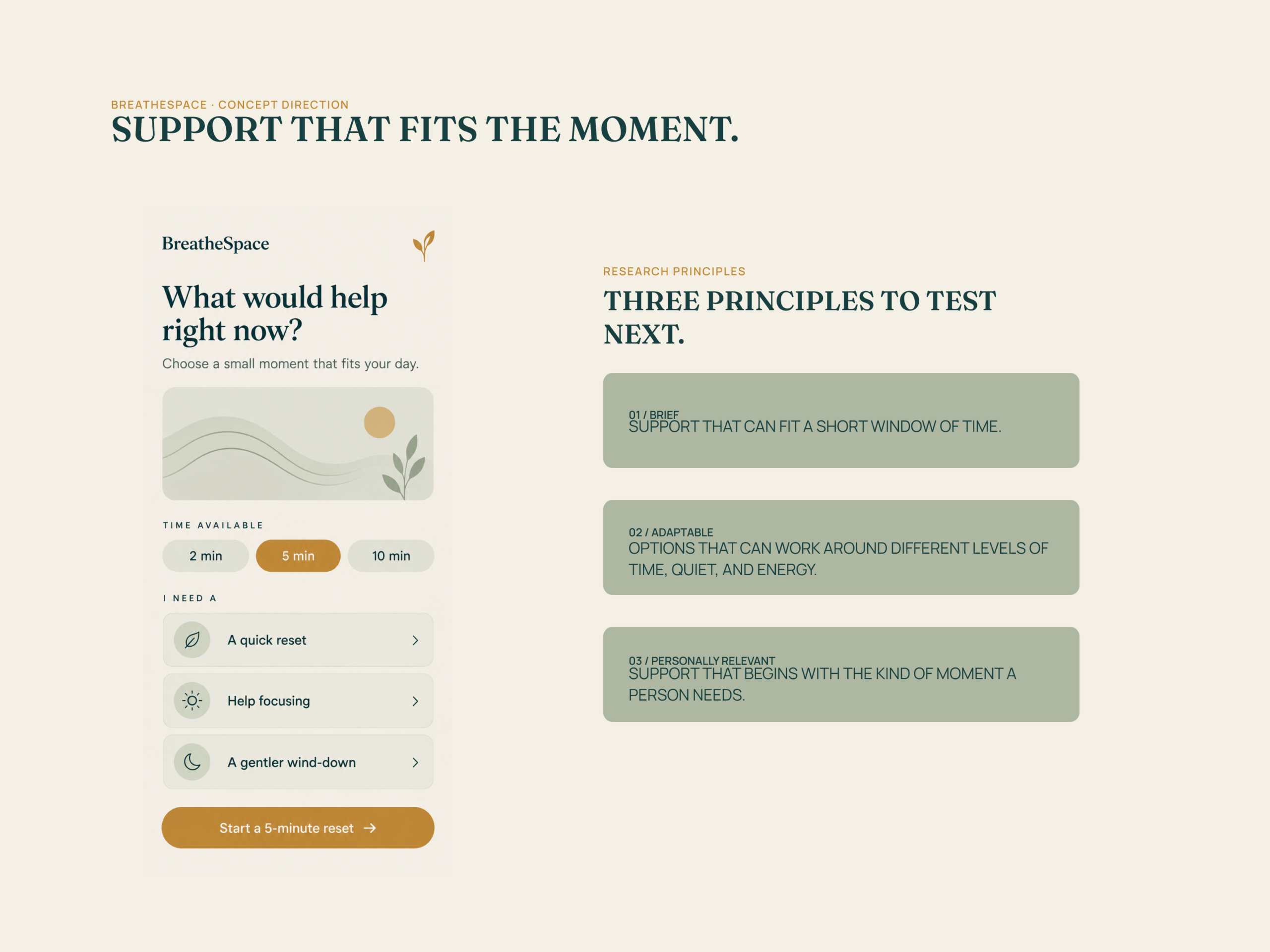
Brief support fits real schedules.
Short moments of support are more approachable when they can fit into the limited time people actually have.
Adaptability respects different needs.
A useful concept needs to work around different levels of time, quiet, and energy rather than assuming ideal conditions.
Personal relevance creates a clearer starting point.
Support should begin with the kind of moment a person is experiencing, not a one-size-fits-all routine.
CONCEPT DIRECTION
Support that fits the moment.
I translated the research into a concept for flexible, low-friction support. The direction begins with a person’s available time and immediate need, then offers a small, approachable next step.
OUTCOME
A focused direction for concept testing.
The research produced three principles for a future concept: support should be brief, adaptable, and personally relevant. These principles created a focused direction without claiming a completed or validated product solution.
TEST NEXT
What concept testing should examine.
The next study should test whether people can quickly recognize their current need, choose a moment that feels manageable, and complete a small support action without added pressure or confusion.
Reflection
Small moments can be a meaningful starting point.
BreatheSpace reinforced the value of narrowing a broad wellness topic into an opportunity people can realistically act on. The work shifted my focus from ideal routines to the small moments when support may be most useful.
PREVIOUS CASE STUDY
WooMe
See how card sorting revealed a furniture-navigation model that reflects how people actually browse.
NEXT CASE STUDY
Balaned Lens
See how a bilingual card-sorting session challenged a default news hierarchy and inspired a more customizable approach to news navigation.