
A mindful approach to news—rooted in empathy, inclusivity, and user choice.
Spoiler Alert
Through card sorting sessions—including one with a Spanish-only participant—I uncovered a surprising pattern: users naturally organized news in ways that prioritized emotional safety, cognitive ease, and cultural relevance rather than traditional media hierarchy. These insights led to a customizable navigation system and bias-aware pathways that give users more control over their experience, reduce overwhelm, and reframe news as something that supports their well-being rather than drains it.

Initial Observation
The existing news and media landscape is saturated and overwhelming. Established platforms like The New York Times, BBC, and NPR deliver extensive content but lack personalization.
Competitor Audit – Key Findings
I used NPR as my primary competitor reference:
- Minimalist design made the site feel approachable and less overwhelming.
- Podcasts are prioritized and organized under categories like Politics, Money, and Culture.
- Technology and Business were deeply interconnected, often leading users between one and the other.
- Navigation was simple, with fewer menu items than most competitors, but had misplaced labels, like Business being oddly categorized under Media.
- Race appeared as its own main category, a rare inclusion among news sites.
- Eight different paths led to the Technology landing page, the highest amount of connections on the site suggesting the organizations push to get users to this page.
Across all competitor sites, the most common categories were:
- World
- U.S.
- Politics
- Business
- Technology
- Science
- Opinion
Despite this consistency, users are still overwhelmed by choice and lack tools to tailor their experience.
Plan
The goal of this case study was to create a news and media platform website and app that provides:
- A personalized experience for users.
- Tools that reduce stress and anxiety when consuming news.
- Features that encourage bias awareness and self-reflection.
My Role
- UX Designer (solo project).
- Conducted card sorting, competitor audits, and IA mapping.
- Created two user flows to illustrate key features.
- Delivered a high-level IA map for both web and app versions.
The Problem
News consumption today is linked to anxiety and avoidance.
- Terms like doom scrolling, headline anxiety, and headline stress disorder are becoming increasingly common.
- A study from the APA found that 50% of adults are stressed because the news doesn’t focus on what’s most important to them personally.
- Another study from Texas Tech University showed that people who obsessively engage with news are significantly more likely to experience mental and physical ill-being.
Key challenge:
How can we create a platform that informs users without harming their mental health — and provides them with the power to control how they engage with news?
Insights
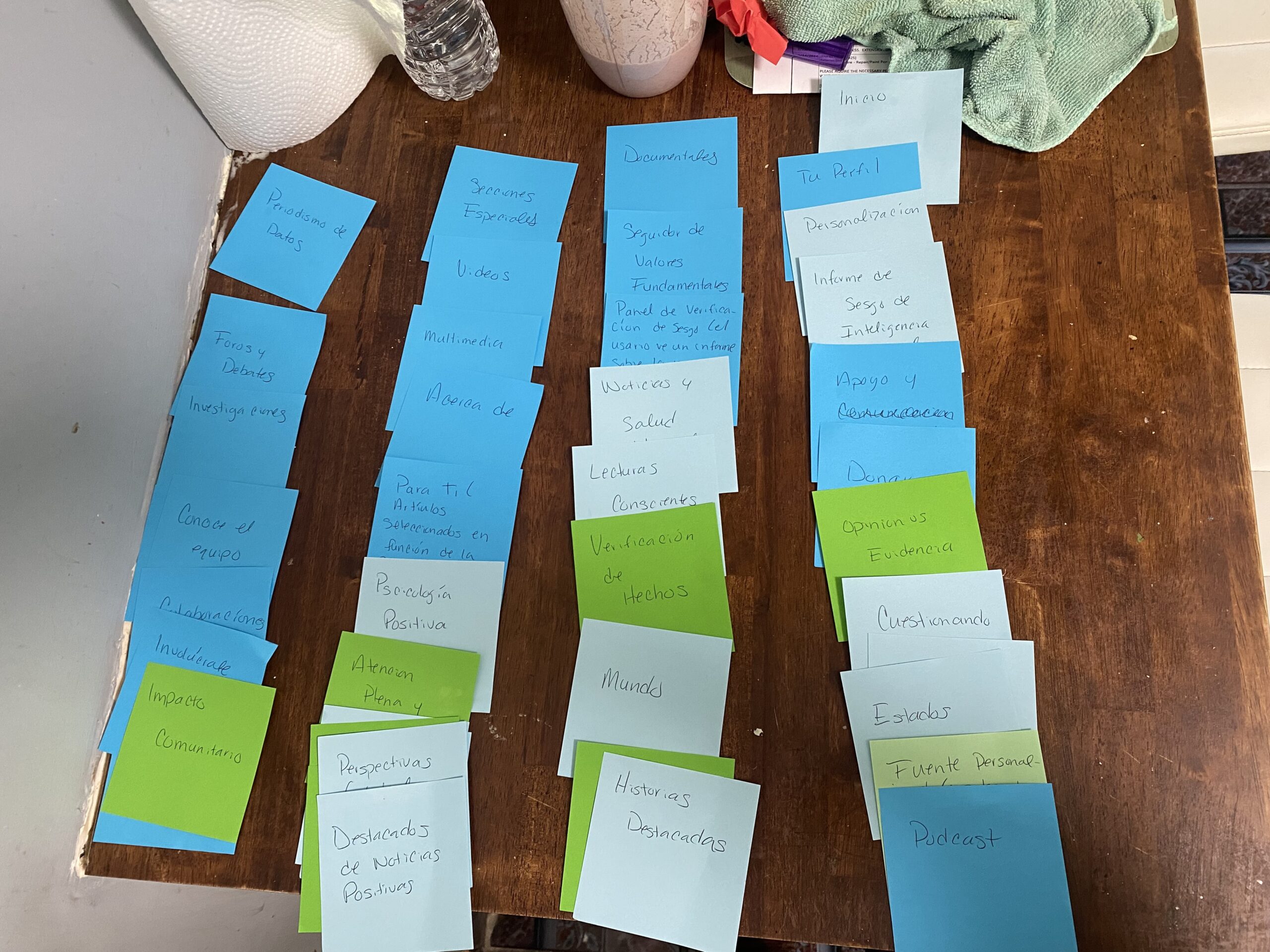
The most powerful insight emerged during an in-person card sorting session with a Spanish-speaking participant.
My Lightbulb Moment:
While observing their process, I noticed how they grouped and labeled cards under the Home navigation menu in a completely different way than native English-speaking participants.
Instead of defaulting to standard “World” or “Politics” groupings, they organized categories based on personal relevance, such as “Family,” “Community,” and “Opportunities.”
This revealed that language and culture strongly influence how users mentally model information.
It sparked the idea for a “Build Your Own Navigation Menu” feature, allowing users to:
- Personalize how they categorize and access news.
- Rename or reorder menu items to fit their worldview.
- Create a safe, meaningful space to engage with media.
Spanish
English

Card sorting Results
IA Map Recommendations
Card Sorting Exercise
-
- Digital card sorting was conducted in Google Sheets for easy collaboration.
- Across all participants, there was a clear preference for personalization rather than default navigation structures seen on traditional platforms.
- Participants collectively sorted navigation menu items to be focused on personalizing the way got to the news they were seeking .
The Spanish-speaking participant validated the need for customizable, user-driven navigation.
- Digital card sorting was conducted in Google Sheets for easy collaboration.
This participant created 4 navigation menu items. But the one that left an impression was the way they categorized "Home"
They created the following sub pages:
Profile ( Tu Perfíl)
Personalize (Personalización)
AI Bias Report ( Informe de Sesgo de Inteligencia Artificial)
Support and Community ( Apoyo y Comunidad)
Donate (Donar)
Opinion vs Evidence (Opinion vs Evidencia)
Challenging Your Bias ( Cuestiona tus Sesgos)
Health US (Salud en EE. UU.)
Personalized Feed (AI driven based on user bias) Feed Personalizado Impulsado por IA según tus sesgos
Podcasts (Podcasts)

IA Map Recommendations
The finalized IA map included the following main navigation categories:
- Home
- Categories
- Featured Stories
- Positive News Highlights
- Challenging Your Bias
- Multimedia
- Special Selections
- For You (personalized feed)
- Profile
- Login
Footer Navigation:
- About
- Meet the Team
- Mission & Values
Partnerships
User Flows
Two key user flows were designed:
- Build Your Own Navigation Menu (Web)
- Users can fully customize their navigation menu without logging in.
- App Version
- Requires login to continue personalizing navigation.
These flows directly support the platform’s mission of user autonomy and mental wellness.
Conclusion/Next Steps
This project reinforced the importance of observing user behavior beyond language barriers.
- The Spanish-speaking participant’s unique approach unlocked an entirely new feature idea that would differentiate Balanced Lens Media in a competitive market.
- It demonstrated how cultural context impacts the way people consume and categorize news.
Next Steps:
- Conduct usability testing focused on the Build Your Own Navigation feature.
- Expand testing to include diverse cultural and linguistic groups.
- Develop wireframes and prototypes that integrate AI-driven personalization and mental wellness tools.
- Explore accessibility features to ensure inclusivity for all users.
- Work with a Web designer to work through building the "Check your Bias" feature that creates visual dashboard that show users how they are leaning any given moment based on what they are reading/watching/consuming on the website/app