
Woome: Rethinking Furniture E-Commerce Through Human Insight
Spoiler Alert
When You Stop Designing for “Industry Norms” and Start Designing for People, Everything Changes
Most furniture e-commerce sites follow the same blueprint: deep category hierarchies, massive menus, endless product pages.
But after analyzing the competitive ecosystem and conducting card-sorting sessions, I discovered something industry patterns consistently overlook:
Users don’t think like websites. They think like humans.
They shop based on how they live — by room, by context, by what makes sense in their home.
And they still need the flexibility to browse by product type when the situation calls for it.
Woome became a redesign rooted in this insight — transforming a product-heavy shopping model into a contextual, intuitive, human-centered navigation system.
This case study highlights my strength in global, systems-level thinking: identifying universal heuristics while honoring the cultural, personal, and intuitive ways people make decisions.

Initial Observation
When You Step Back, Patterns Start to Reveal Themselves
My early research began by studying the dominant players shaping the furniture space: Wayfair, Crate & Barrel, and Burrow.
Across brands, I noticed a shared set of heuristics:
-
Massive category menus that assume users already know what they want
-
Overly product-driven navigation that puts items before context
-
Visual storytelling gaps that either overwhelm (Wayfair), over-stylize (Crate & Barrel), or oversimplify (Burrow)
But beneath their differences was a deeper universal truth:
People understand their homes through spaces first — not SKU lists.
Big-box navigation had been teaching us to think in product silos, but user patterns told a different story.
This is where I saw the opportunity.
Plan
Study the Market, Then Study the Mind
To validate the patterns I saw (and challenge my own assumptions), I created a structured research plan:
1. Competitive Analysis
To map the norms, the gaps, and the friction patterns users face across major retailers.
2. Card Sorting Exercises
To observe how real users actually organize their mental models of furniture and home goods — not how the industry assumes they do.
3. Site Mapping
To reimagine an IA that blends industry familiarity with a fresh design perspective grounded in anthropology, behavior, and lived human experience.
Tools Used:
Mural • Google Forms • Google Sheets
The Problem
Much of Furniture E-Commerce Forces Users Into Boxes They Don’t Live In
The current online shopping ecosystem:
-
Assumes users think like retailers
-
Overwhelms them with too many choices
-
Buries universal items like art, rugs, and mirrors
-
Creates friction between “room-first” and “product-first” browsing
In reality, users need:
- Context (How will this look in my space?)
- Flexibility (Can I shop my way?)
- Clarity (Where do I start?)
The disconnect between industry heuristics and actual human behavior created the exact friction Woome set out to solve.
Insights
What Users Taught Me About How People Actually See Their Homes
From my card-sorting sessions and competitive research, several insights crystalized:
🏠 1. Users naturally think in “room-first” mental models
Especially for bigger pieces, people start with the space they are designing — not the item itself
I conducted a pre and post card sorting survey to better understand how people really behave vs what they say/think they do when considering how they shop for furniture online. The pre-card sorting survey showed that participants used both online methods to shop for furniture (mobile and laptop), a few times a year to rarely. They claimed that when they did shop they predominantly shopped by product type. The card sorting exercise showed that when given the resources to create, they will categorize by room first.

2. Universal decor lives in both worlds
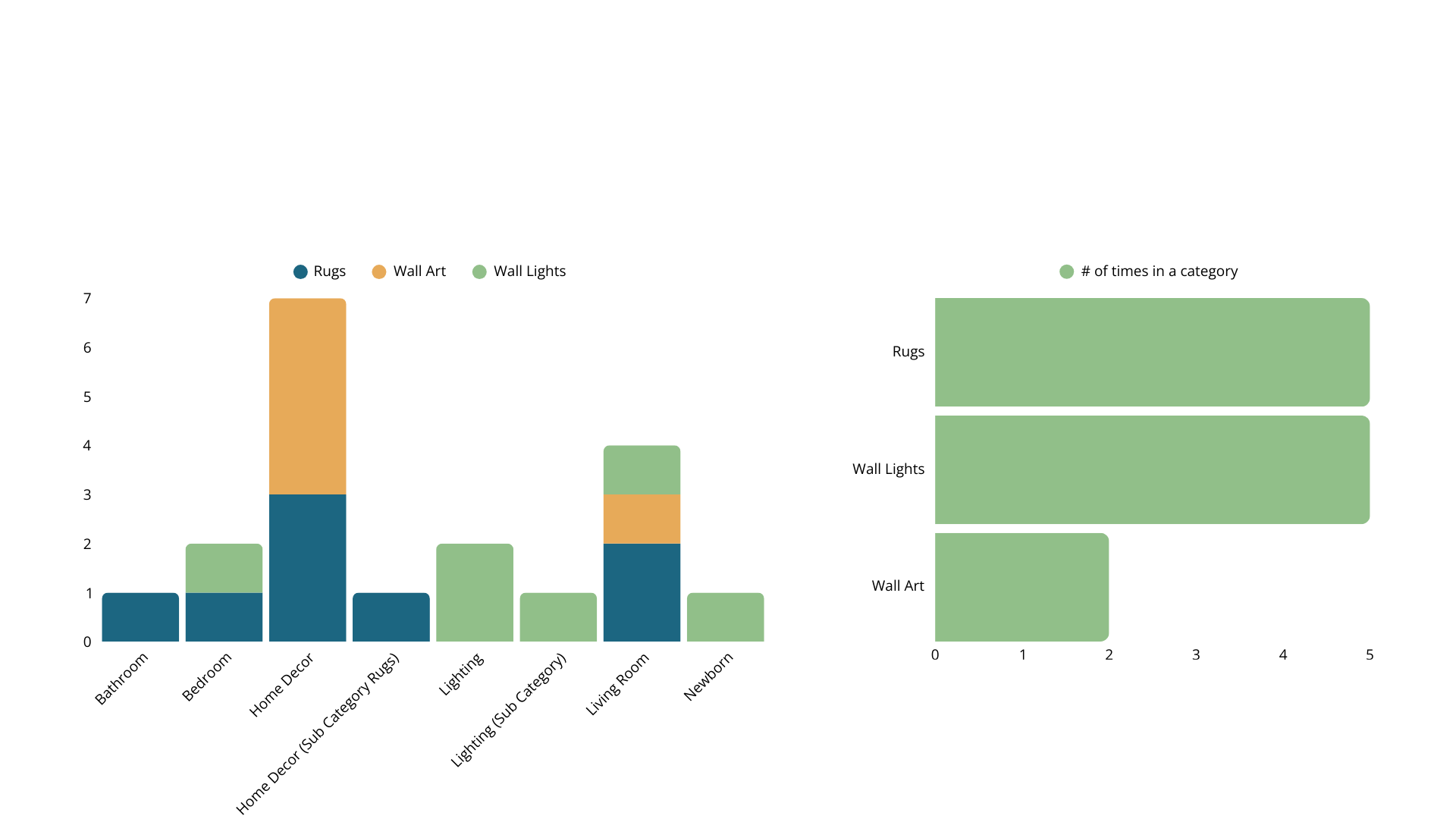
Items like rugs, mirrors, wall art, and lighting fluidly belong to both:
➡️ the room you’re designing
➡️ the product category you prefer to browse
This flexibility became central to the redesigned navigation.
Subcategories revealed two mental models: space-based and style-based.
User selections showed a strong preference for Room Type when shopping for larger furniture pieces—Dining Room, Living Room, and Bathroom together represented nearly half of all Furniture responses (see pie chart). This confirms that users anchor big purchases around the spaces they are actively designing.

But when looking at items like rugs, mirrors, and wall art, an entirely different pattern emerged. As shown in the treemap, these pieces consistently appeared across multiple user-created categories, behaving as universal décor rather than room-specific items. Rugs and wall art, in particular, surfaced repeatedly across top categories, signaling that users see these items as flexible styling elements rather than fixed room assignments.
Understanding this split was crucial. It validated the need for a navigation system that supports both:
-
Room-based shopping for foundational items
-
Universal décor browsing for flexible, style-driven decision-making
This dual-path IA ultimately reflects how people actually shop—not how most furniture websites assume they do.

3. “Kids & Baby” and “Outdoor” revealed strong universal mental models.
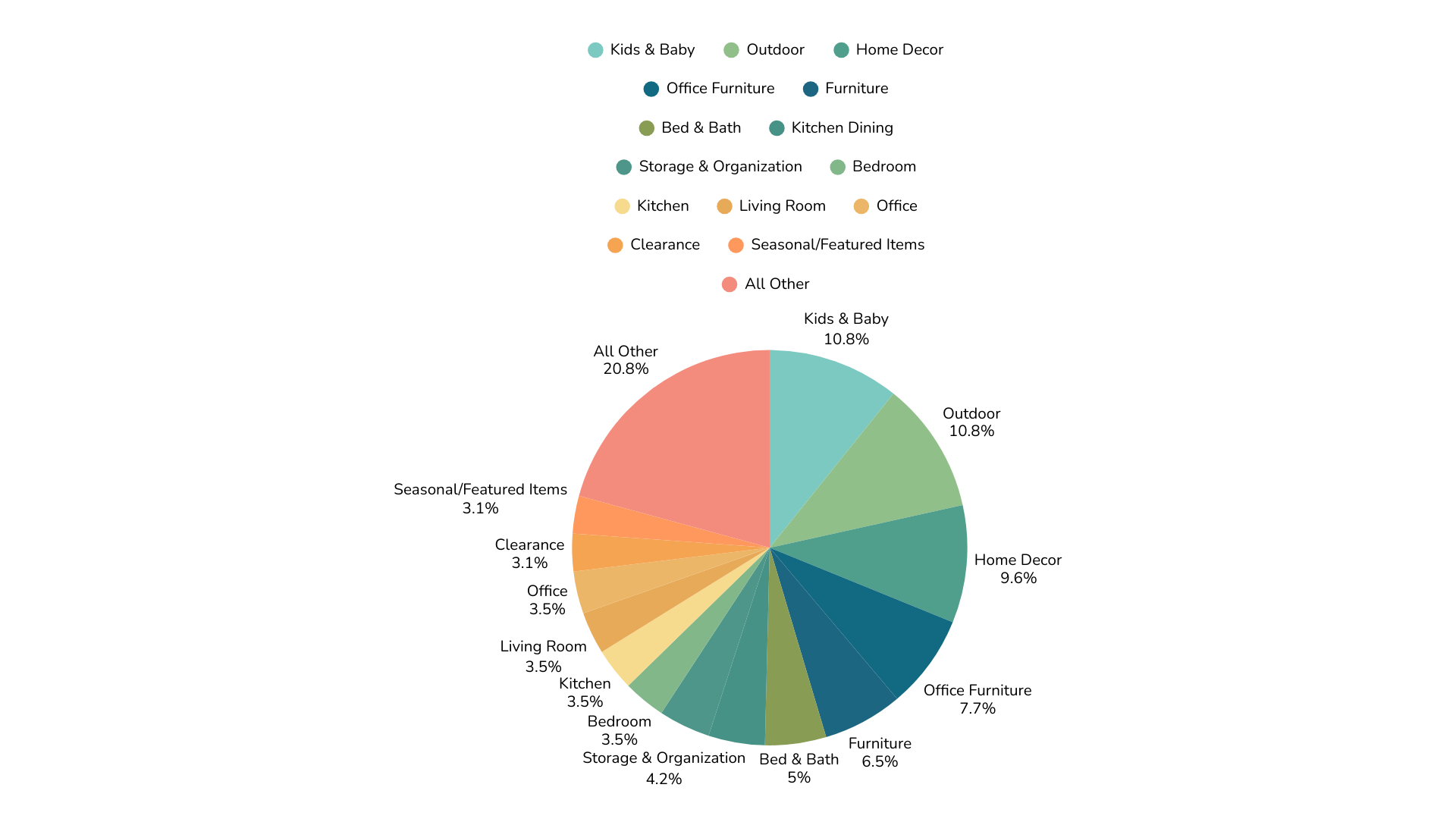
Across all card-sorting sessions, Kids & Baby and Outdoor emerged as the two most consistently created categories—each appearing in more than 20% of participant groupings. What stood out was not just their frequency, but their consistency:
-
Participants placed nearly the same number of subcategory items into each of these two groups.
-
The only difference was that Outdoor included one additional subcategory, suggesting slightly more variation in how users conceptualize outdoor spaces.
✨ What this revealed:
Users share remarkably similar mental models for both Kids & Baby and Outdoor spaces. These categories function as “micro-worlds” in the home—distinct, clearly defined, and easy for users to sort intuitively without hesitation.
This consistency signals that these two categories should be prominently featured in the navigation structure, as users already view them as cohesive, self-contained ecosystems within the broader home environment.

4. Users crave options, not limitations
By giving people the ability to browse by room or product, we allow them to express how they think — not force them into a rigid system.
Card sorting Results
Final Site Map Recommendations
Across 7 sessions:
-
Ages 25–34
-
Average income ~$75K
-
Online shoppers who use both desktop and mobile
-
6 virtual sessions + 1 in-person
Users told me far more through how they sorted items than through their survey answers.
What I learned:
- Good design comes from honoring how people already make sense of their world.
- A “choose-your-own-journey” navigation system creates inclusivity, not complexity.
- When users feel understood, friction disappears.

A Navigation System Rooted in Humanity, Not Industry Tradition
Primary Navigation:
- Sale
- Shop by Room Type
- Shop by Product Type
Subcategories:
- Shop by Room Type
- Outdoor
- Bedroom
- Bathroom
- Living Room
- Office
- Kitchen and Dining
- Shop by Product Type
- Storage and Organization
- Bed and Bath
- Furniture
- Office Furniture
- Home Decor
- Kids and Baby
A structure that invites, guides, and adapts — built from what users intuitively expect, not what e-commerce templates default to.
Conclusion/Next Steps
Woome reflects my ability to:
-
Zoom out and understand industry-wide heuristics
-
Identify what’s missing from the competitive landscape
-
Ask cross-cultural questions that reveal deeper behavioral patterns
-
Translate research into a fresh, intuitive, human-centered design system
By rooting the experience in how people think, not how companies categorize, Woome transforms furniture shopping into something that feels natural, fluid, and deeply connected to real life.
Next Steps
-
Build high-fidelity wireframes
-
Conduct usability testing on both browsing paths
-
Refine the IA based on cross-user behavior patterns